
Gender selection in Egypt is an option some couples explore to identify an embryo’s sex before pregnancy. The procedure usually combines in vitro fertilization (IVF) with preimplantation genetic testing (PGT). Couples commonly ask about the cost, treatment stages, accuracy, success rate, legal status, and time required. Outcomes depend on factors such as the woman’s age, ovarian reserve, embryo quality, medical history, laboratory standards, and applicable regulations.
What Is Gender Selection Through IVF?
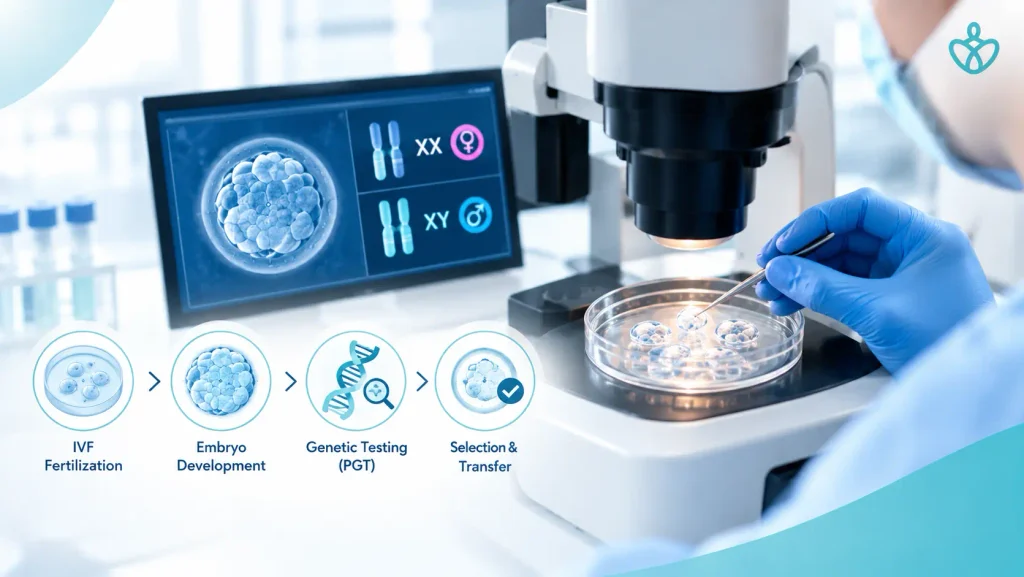
Gender selection through IVF involves fertilizing eggs with sperm in a laboratory, developing the embryos, and testing them before transferring one to the uterus. Depending on the test used, PGT can identify sex chromosomes and detect certain genetic or chromosomal conditions.
Treatment begins with ovarian stimulation to produce several eggs. After retrieval, the eggs are fertilized, often using intracytoplasmic sperm injection (ICSI). Embryos are monitored until they reach the appropriate stage, when a small cell sample is collected for testing. Once the results are available, the medical team evaluates the embryos and selects one for transfer based on genetic findings, embryo quality, and medical considerations.
How Does Gender Selection IVF Work in Egypt?
The process generally includes the following stages:
- Medical assessment: Both partners undergo fertility evaluations, which may include ovarian reserve tests, semen analysis, ultrasound, and other investigations.
- Ovarian stimulation: Fertility medications are used to encourage the ovaries to develop multiple eggs, while ultrasound examinations and blood tests help monitor the treatment response.
- Egg retrieval: Once the eggs are mature, they are collected from the ovaries through a minimally invasive procedure performed under suitable sedation or anesthesia.
- Fertilization: ICSI may be used to inject one sperm into each suitable egg. The embryos are then monitored in the laboratory.
- Preimplantation genetic testing: Embryos that develop adequately undergo biopsy.
- Embryo selection and transfer: A suitable embryo is selected according to the test results, embryo quality, and medical plan. In many cases, embryos are frozen while results are processed.
- Pregnancy testing: A blood test is used to confirm pregnancy at the time advised by the fertility specialist.
Understanding the stages of Gender Selection in Egypt can help couples prepare for medical appointments, genetic testing, and embryo transfer.
If no suitable embryo of the desired sex is available, another cycle may be necessary. Even when an appropriate embryo exists, transfer may not result in pregnancy.
What Is the Cost of Gender Selection in Egypt?
The cost varies between fertility centers and depends on the treatment plan. The total may include consultations, medications, IVF or ICSI, embryo culture, PGT, embryo freezing, storage, transfer, and follow-up care. The main factors affecting cost include:
- Stimulation medications: The dosage and type of medication depend on the woman’s age, ovarian reserve, and response.
- IVF and ICSI: Fees may cover egg retrieval, fertilization, laboratory monitoring, and embryo development.
- Genetic testing: Costs vary according to the test type, laboratory, number of embryos tested, and whether additional genetic conditions are assessed.
- Embryo freezing and storage: These may be charged separately, especially when transfer occurs in a later cycle.
- Embryo transfer: Preparation of the uterine lining, transfer, and follow-up tests may add to the total.
- Additional cycles: More treatment may be required if few eggs are retrieved, no suitable embryos develop, or pregnancy does not occur.
When comparing the cost of Gender Selection in Egypt, couples should consider the complete treatment plan rather than the advertised price of IVF alone. Requesting a detailed quotation can help clarify which services are included and whether additional fees may apply.
What Is the Success Rate of Gender Selection IVF?
Success should be understood through several separate measures: the accuracy of identifying sex chromosomes, the chance of obtaining a suitable embryo, the pregnancy rate after transfer, and the live birth rate.
PGT can identify sex chromosomes with very high accuracy when performed by a qualified laboratory. However, not every cycle produces an embryo of the desired sex, and not every tested embryo is suitable for transfer. Pregnancy and live birth also depend on factors such as:
- The woman’s age and ovarian reserve.
- The number of eggs retrieved.
- Egg and sperm quality.
- The number of embryos available for testing and their overall quality.
- Genetic test results.
- Uterine health and implantation conditions.
- The experience of the fertility team and embryology laboratory.
Couples should ask for an individualized assessment rather than relying on a single advertised success rate. Clinics should clearly distinguish between testing accuracy, clinical pregnancy rates, and live birth rates.
How Accurate Is PGT for Gender Selection?
PGT analyzes the genetic material in a small sample of cells collected from the embryo. Depending on the method, it can identify sex chromosomes and certain genetic or chromosomal abnormalities.
Sex chromosome identification is generally highly accurate, but it is not absolutely infallible. Limited samples, embryonic mosaicism, technical errors, and laboratory factors may affect interpretation. In addition, PGT cannot predict with certainty whether an embryo will implant, continue developing, or result in a healthy birth.
What Is the Difference Between PGD and PGT?
Preimplantation Genetic Diagnosis (PGD) is an older term often used for testing embryos for a specific inherited disorder. Preimplantation Genetic Testing (PGT) is the broader and more current term.
The main types include:
- PGT-M: Tests for specific single-gene disorders.
- PGT-A: Assesses chromosome numbers and may identify extra or missing chromosomes.
- PGT-SR: Detects certain structural chromosomal rearrangements.
Some PGT methods can identify sex chromosomes, but not every PGT test includes sex identification. Couples should confirm the purpose and scope of the proposed test before treatment.
Can You Choose a Boy or Girl With IVF?
IVF combined with preimplantation genetic testing (PGT) can identify embryos with sex chromosomes typically associated with male or female development. However, Choosing an embryo of the desired sex depends on the availability of a suitable embryo and the regulations governing the procedure.
A cycle may not produce embryos of the desired sex, and some embryos may not be suitable for transfer because of genetic findings or poor development. Selecting an embryo also does not guarantee implantation, pregnancy, or a live birth.
The medical and legal rules may differ between selection intended to prevent a sex-linked genetic disorder and selection for non-medical reasons. Couples should discuss eligibility and ethical considerations with their fertility specialist.
How Long Does the Process Take?
The process usually takes several weeks and may extend to a month or longer. The timeline depends on the treatment plan, ovarian response, genetic testing, and transfer schedule.
- Initial assessment: Several days to a few weeks.
- Ovarian stimulation: Usually about 8–14 days.
- Egg retrieval and fertilization: Performed after stimulation, followed by embryo monitoring.
- Embryo development and biopsy: Usually around 5–7 days after fertilization.
- Genetic testing: Results may require several additional days.
- Embryo transfer: Often performed in a later cycle after freezing and preparation of the uterine lining.
The process may take longer if additional tests are needed, no suitable embryo is available, or transfer is postponed for medical reasons.
How to Choose a Clinic in Egypt?
When comparing clinics, couples should consider:
- Licensing to provide assisted reproductive services.
- The fertility specialist’s experience.
- The quality and accreditation of the embryology laboratory.
- The genetic testing method and its limitations.
- Transparent success rates for patients of similar ages.
- A written estimate covering all expected costs.
- Access to genetic counseling.
- Follow-up care after embryo transfer.
Who Is the Best IVF and Gender Selection Doctor in Egypt?
Dr. Mahmoud El Naggar is a specialist in IVF and gender selection in Egypt. He is a consultant in IVF, test-tube baby procedures, and infertility, and holds a PhD in Obstetrics, Gynecology, and Infertility. With 15 years of experience in IVF and fertility treatment, he has helped many couples achieve their family-planning goals, including cases involving gender selection. His professional profile reports more than 4,000 successful cases. He is also a member of the European Society of Human Reproduction and Embryology (ESHRE) and the Egyptian Fertility and Infertility Society. In addition, he works as a consultant in Obstetrics and Gynecology at the Educational Hospitals and Institutes Authority in Egypt. His services include IVF, test-tube baby procedures, gender selection, surgical endoscopy, artificial insemination, high-risk pregnancy follow-up, and pain management.
Frequently Asked Questions
How Much Does Gender Selection Cost in Egypt?
The cost depends on medications, IVF or ICSI, genetic testing, the number of embryos tested, freezing, storage, and embryo transfer. Couples should request a detailed quotation that lists included and additional services.
Is Gender Selection Available in Cairo?
Some Cairo fertility centers provide IVF and genetic testing, but availability depends on the clinic’s services, laboratory facilities, and applicable regulations. Couples should contact licensed centers directly.
Can IVF Guarantee the Gender of a Baby?
No. PGT can identify sex chromosomes with high accuracy, but a cycle may not produce a suitable embryo of the desired sex. Embryo selection also cannot guarantee pregnancy or a live birth.
What Is the Accuracy Rate?
Accuracy is generally very high when testing is performed by a qualified laboratory, but it is not absolute. Results may be affected by the testing method, sample quality, mosaicism, and laboratory procedures.
How Can Couples Choose a Clinic?
They should verify licensing, specialist experience, laboratory quality, testing methods, total cost, success-rate reporting, counseling services, and follow-up care.
All these criteria are met by Dr. Mahmoud El Naggar, who has 15 years of experience in IVF, infertility treatment, and gender selection, along with specialized medical qualifications.
Book a consultation with Dr. Mahmoud El Naggar to discuss your options, understand the treatment process, and receive a personalized assessment based on your medical needs.
References
Human Fertilisation and Embryology Authority (HFEA). Pre-implantation Genetic Testing for Aneuploidy
European Society of Human Reproduction and Embryology (ESHRE). Chromosomal Mosaicism in PGT.